
Everything Families Should Expect During Stage 6 Severe Dementia

How Long Does Stage 6 Dementia Last?
Stage 6 of Alzheimer’s disease lasts about 2.5 years on average, though one person’s timeline may be much shorter or longer. This estimate covers all five stage 6 substages. It is a planning guide, not a countdown to the end of life.
Stage 6 brings growing need for help with dressing, bathing, and toileting. If your parent needs more help with these tasks, tell their care team what has changed and ask them to reassess their needs. That is more useful for planning care than relying on an average alone.
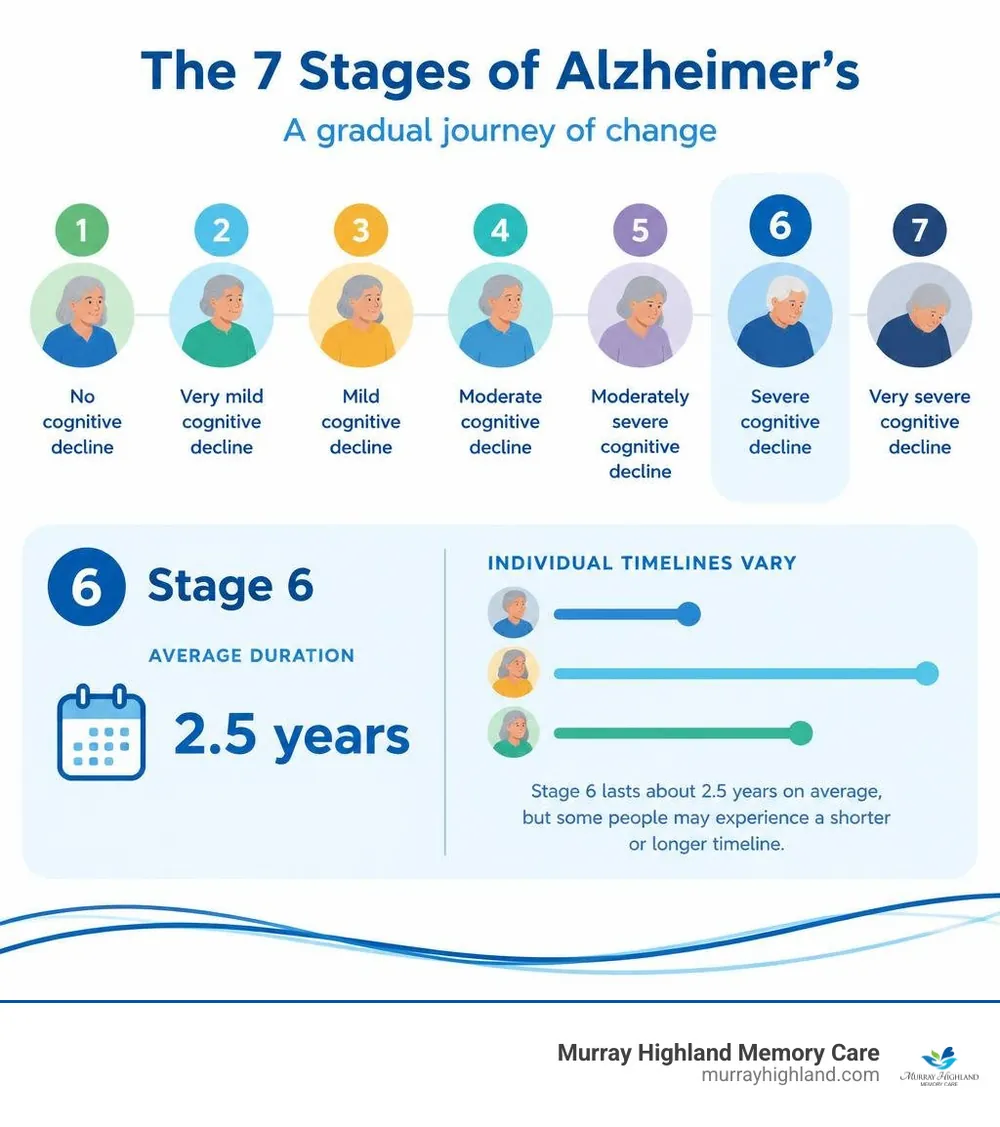
When Dr. Barry Reisberg developed the Global Deterioration Scale (GDS) and the Functional Assessment Staging Tool (FAST), he provided families and clinicians with a clear framework to measure functional decline. In 2026, understanding where your loved one stands along this continuum remains one of the best ways to prepare for changing needs, ensure physical safety, and protect their daily quality of life.
Defining Stage 6: Severe Cognitive Decline and Key Characteristics

Stage 6—often referred to clinically as moderately severe dementia or severe cognitive decline—is marked by a crucial shift: the transition from needing prompts to requiring hands-on help with basic activities of daily living (ADLs). In earlier phases, individuals struggle with complex tasks like balancing a checkbook or remembering recent events. By Stage 6, progressive neurodegeneration affects core motor planning and self-care skills.
Families navigating the stages of Alzheimer’s often find Stage 6 to be the most emotionally demanding period. While individuals retain long-term emotional memories, they often experience:
- Significant Memory Gaps: Forgetting recent events, major life milestones, or confusing the names of spouses and primary caregivers.
- Communication Obstacles: Expressive and receptive language narrows, leading to repetitive questioning, word substitutions, or reliance on non-verbal cues.
- Circadian Rhythm Disruptions: “Sundowning” becomes common, where confusion, restlessness, and agitation intensify in the late afternoon and evening.
- Behavioral & Psychological Symptoms: Delusions, anxiety, obsessive behaviors (such as pacing or trailing caregivers), and paranoia may arise as the brain struggles to interpret the surrounding environment.
The 5 Substages from FAST 6a to 6e
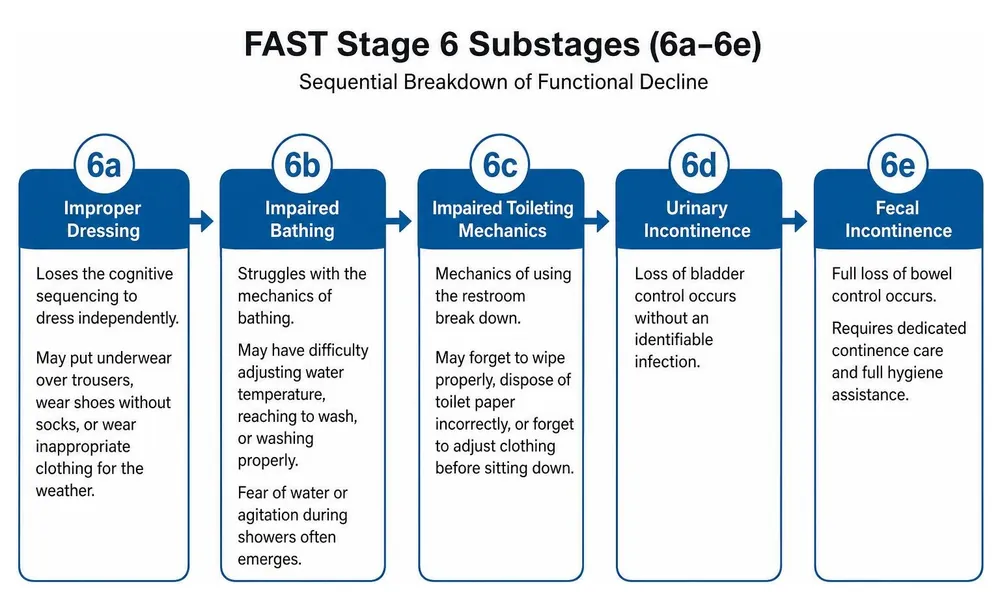
Clinical staging tools provide fine granularity during this phase. According to practical guidance on Functional Assessment Staging in dementia, Stage 6 breaks down into five distinct, sequential substages:
- Stage 6a (Improper Dressing): The individual loses the cognitive sequencing necessary to dress independently. They might put underwear over trousers, slip into shoes without socks, or attempt to wear a winter overcoat in the middle of July.
- Stage 6b (Impaired Bathing): The person struggles with the mechanics of bathing, such as adjusting water temperatures, reaching to wash their back, or washing properly. A fear of water or agitation during showers often emerges.
- Stage 6c (Impaired Toileting Mechanics): The mechanics of using the restroom break down. The person may forget to wipe properly, dispose of toilet paper incorrectly, or forget to adjust their clothing before sitting down.
- Stage 6d (Urinary Incontinence): The individual experiences loss of bladder control, occurring without an identifiable infection.
- Stage 6e (Fecal Incontinence): Full loss of bowel control occurs, requiring dedicated continence care and full hygiene assistance.
How Long Does Stage 6 Dementia Last? Average Timeline and Staging Scales
When asking how long does stage 6 dementia last, the answer varies depending on which clinical framework is applied. On average, across standard medical observations, Stage 6 spans roughly 2.5 years in otherwise healthy individuals. However, across various staging models and observational studies, clinical estimates can range from 1 to 4 years, and in some broader definitions, up to 8 years.
Clinical literature outlined by Dementia Care Central’s stage and progression guides highlights how different clinical assessment scales evaluate this timeframe:
| Assessment Scale | Stage Equivalent | Average Duration Estimate | Clinical Focus |
|---|---|---|---|
| Global Deterioration Scale (GDS) | Stage 6 (Severe Cognitive Decline) | ~2.5 years (typical range: 2–4 years) | Comprehensive cognitive and functional milestones |
| Functional Assessment Staging (FAST) | Stage 6 (Substages 6a through 6e) | ~3.5 to 9.5 months per substage (cumulative ~2.5 years) | Specific loss of physical self-care capabilities |
| Clinical Dementia Rating (CDR) | Stage 3 (Severe Impairment) | 1 to 2.5 years | Broad judgment of memory, orientation, and community affairs |
How Long Does Stage 6 Dementia Last Across Different FAST Substages?
The FAST scale offers a breakdown of how individuals move through moderately severe dementia. According to the FAST tool clinical management guide, the expected untreated durations for each sub-phase are:
- Substage 6a (Dressing): ~4.8 months
- Substage 6b (Bathing): ~4.8 months
- Substage 6c (Toileting Mechanics): ~3.6 to 4.8 months
- Substage 6d (Urinary Incontinence): ~3.6 to 4.8 months
- Substage 6e (Fecal Incontinence): ~1.5 to 2.5 months
Cumulatively, an individual progresses through these specific self-care losses over 18 to 30 months (averaging 2.5 years). High-quality supportive care, proper nutrition, prompt infection management, and personalized behavioral therapies can help stabilize individuals and support quality of life throughout these transitions.
Factors Influencing How Long Stage 6 Dementia Lasts
No two journeys are identical. Several biological and environmental elements influence how quickly a person moves through Stage 6:
- Age and Biological Sex: Younger individuals diagnosed with early-onset dementia often experience faster progression, while older seniors may progress more slowly. On average, women survive slightly longer with Alzheimer’s than men.
- Underlying Diagnosis: Different types of dementia progress along unique paths. Vascular dementia may progress in sudden steps following micro-strokes, whereas Lewy body dementia often features fluctuating cognition and earlier physical changes.
- Overall Physical Health: Pre-existing cardiovascular disease, diabetes, or renal conditions can shorten stage duration through secondary health complications.
- Infections and Delirium: Acute events like urinary tract infections (UTIs) or pneumonia can trigger delirium—a sudden spike in confusion that accelerated decline if not treated quickly. In fact, medication side effects and metabolic disruptions cause roughly 39% of delirium cases in elderly adults.
- Routine and Environmental Stability: Disruptions in routine, relocation stress, or overstimulating environments can increase anxiety and functional confusion.
Comparing Stage 6 to Stages 5 and 7: Symptoms and Life Expectancy
To better understand where Stage 6 fits within the overall progression of dementia, it helps to compare it directly to the stages immediately preceding and following it.
| Metric | Stage 5: Moderately Severe (Moderate Dementia) | Stage 6: Severe Decline (Moderately Severe Dementia) | Stage 7: Very Severe (Late/End-Stage Dementia) |
|---|---|---|---|
| Core Symptoms | Forgets address/phone number; disoriented to date; needs help picking weather-appropriate clothing. | Needs hands-on help dressing, bathing, toileting; incontinence; wandering; personality changes. | Loss of verbal speech (1–5 words); inability to walk or sit up unsupported; swallowing difficulties. |
| Independence Level | Retains basic ADL independence (can feed and toilet themselves without physical help). | Loses basic ADL independence; requires 24/7 care and supervision. | Completely dependent for all bodily functions and physical positioning. |
| Average Stage Duration | ~1.5 years (range: 1–2 years) | ~2.5 years (range: 2–4 years) | ~1 to 2.5 years (up to 5 years with intensive nursing) |
| Typical Life Expectancy | 4 to 8+ years | 2 to 4 years | 6 months to 2 years |
How to Manage Care Needs and Daily Challenges During Stage 6
Caring for someone in Stage 6 requires moving from simple reminders to proactive, full-time physical support. Because safety risks like wandering and hygiene neglect increase, families must build strong care routines.
- Dressing Simplification: Lay out clothing items in the order they should be put on. Replace complex buttons, ties, and zippers with elastic waistbands and velcro closures.
- Low-Stress Bathing: Bathrooms can feel cold and frightening to someone with severe dementia. Warm the room beforehand, install sturdy grab bars, use handheld showerheads, and consider sponge baths on alternating days to prevent distress.
- Compassionate Continence Management: Establish a predictable toileting schedule (every 2 to 3 hours). Use discreet, high-absorbency protective undergarments and gentle skin barrier creams to prevent breakdown.
- Creating a Calming Environment: Manage sundowning by maintaining steady daytime lighting, reducing loud noises or television chatter in the evening, and playing soothing music.
Recognizing signs that your loved one may need memory care is an essential step when 24/7 home supervision becomes unsustainable. In dedicated settings, personalized care approaches in memory care communities ensure residents receive continuous physical assistance while engaging in therapeutic activities tailored to their functional abilities.
Recognizing End-of-Life Transitions and Hospice Considerations
As severe dementia progresses toward its final phase, care priorities naturally shift toward comfort, pain management, and dignity. Insights from research on navigating late-stage dementia by the Alzheimer’s Association (Clifford et al., 2024) show that although verbal abilities decline, individuals retain their identity and benefit deeply from sensory connection, music, and compassionate touch.
According to clinical criteria outlined in Amedisys guides on the FAST scale for dementia, patients become eligible for Medicare hospice benefits when they reach FAST Stage 7a (speech limited to fewer than six intelligible words) alongside a six-month prognosis and one or more secondary complications:
- Severe weight loss or difficulty swallowing (dysphagia)
- Aspiration pneumonia or recurrent severe UTIs
- Multiple Stage 3 or 4 pressure ulcers
- Persistent fever or systemic infections
Families should review advance directives early in Stage 6 to ensure care preferences—such as avoiding invasive feeding tubes, which offer no proven clinical benefit in late-stage dementia—are documented and honored.
Frequently Asked Questions About Stage 6 Dementia
What is the life expectancy for a person in stage 6 dementia?
The average life expectancy for an individual in Stage 6 dementia is generally between 2 and 4 years. Remaining life expectancy is shaped by overall physical health, cardiovascular function, and the prevention of secondary complications like falls, delirium, and respiratory infections.
Can a person skip substages in stage 6 dementia?
In classic Alzheimer’s disease, functional decline almost always follows the sequential FAST order (6a through 6e). If an individual suddenly skips a substage—such as losing continence before having trouble with dressing—clinicians will evaluate for non-dementia causes, such as an acute UTI, medication side effect, or a vascular event.
When should families consider residential memory care?
Families should explore residential care when home safety risks escalate, physical care needs exceed what family caregivers can safely manage, or caregiver burnout sets in. Learning who qualifies for memory care helps families transition their loved ones smoothly before an emergency or acute hospitalization occurs.
Conclusion
Understanding the progression and duration of Stage 6 dementia allows families to plan with confidence, empathy, and practical foresight. While the average timeline of 2.5 years offers a general clinical benchmark, focusing on comfort, dignity, and personalized daily support matters most.
At Murray Highland Memory Care, we provide boutique, family-owned residential memory care right in Beaverton, Oregon. Our warm, home-like environment offers personalized 24/7 care, chef-prepared meals, and an attentive setting designed specifically for seniors navigating Alzheimer’s and other dementias. If you are exploring care options for your loved one, learn more about the stages of Alzheimer’s and how memory care can support your family.
Scientific References
Clifford K, Moreno M, Kloske CM. “Navigating late-stage dementia: A perspective from the Alzheimer’s Association..” Alzheimer’s & dementia (Amsterdam, Netherlands), 2024. PMCID PMC10941565.